
Wargaming Future ‘Modern’ conflicts
How will future war-games adept to what is now considered ‘Modern Warfare?’

NOTE: I think I started writing this article way back in 2024 but decided to dust it off and reconsider after my year long experience of writing on Substack. I hope you all enjoy, though admittedly this article is more questions than answers.
For a long time modern commercial wargaming has primarily concerned itself with combat involving relatively small unit actions and counter terrorism.
The likes of the ‘Spectre’ rules set, as well as various ‘Force on Force’ books do an excellent job of allowing players to re-fight intensive combat in the likes of Iraq, Afghanistan and other regions.
They are good systems and great for the likes of 28 to 15 mm scale wargaming
However, with the war in Ukraine, recent conflicts in the middle east and many other locations, what is defined as ‘modern’ warfare has taken a massive step forward.
Ukraine is not a long-term counter terrorism or insurgency operation (though Russia would dearly love to label it that way). The war in Ukraine is a peer-to-peer conflict using the very latest in East and West technology and tactics, that are constantly evolving. It is a high intensity conflict involving thousands of troops across a vast expanse of Europe. Whilst special forces operations are extensive, this war has involved, and continues to involve, very large battles between hundreds of troops and vehicles on a regular basis.
In the future, how will war-games rules re-fight or re-create such a conflict? And how will they let players game possible near future conflicts? And how will the likes of NATO adapt their wargames to the new modern battlefield?
Below are a few considerations.
Drones
How will drones affect modern warfare?
Will ‘cope cages’ and other tank adoptions become a standard for armoured vehicles? Will anti-drone electronic warfare components enter into the category of ‘required’ kit? And what about the likes of fighter-drones or even personal firearms designed to shot down drones?
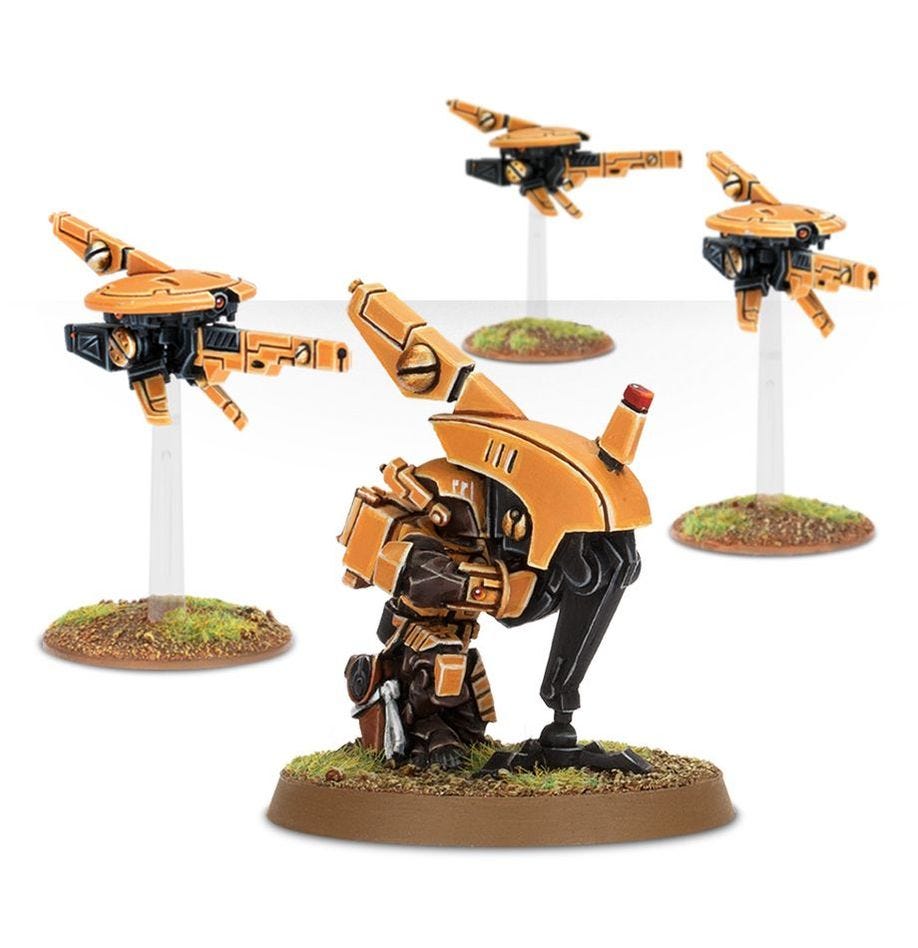
A Tau sniper drone team from the Warhammer 40k wargame. We’re not there yet...but soon?
Will future war-games integrate such tech as a matter of course or will it be a purchasable upgrade for certain armies? Will certain modern armies, especially Russia and the United States, have ECM (Electronic Counter Measures) as standard on their most valuable equipment?
Which leads us to...
Electronic Counter Measures
As Drones have become more and more effective and numerous on the battlefield, the inevitable push back from ECM is building.
In this regard, some rule sets are ahead of the game.
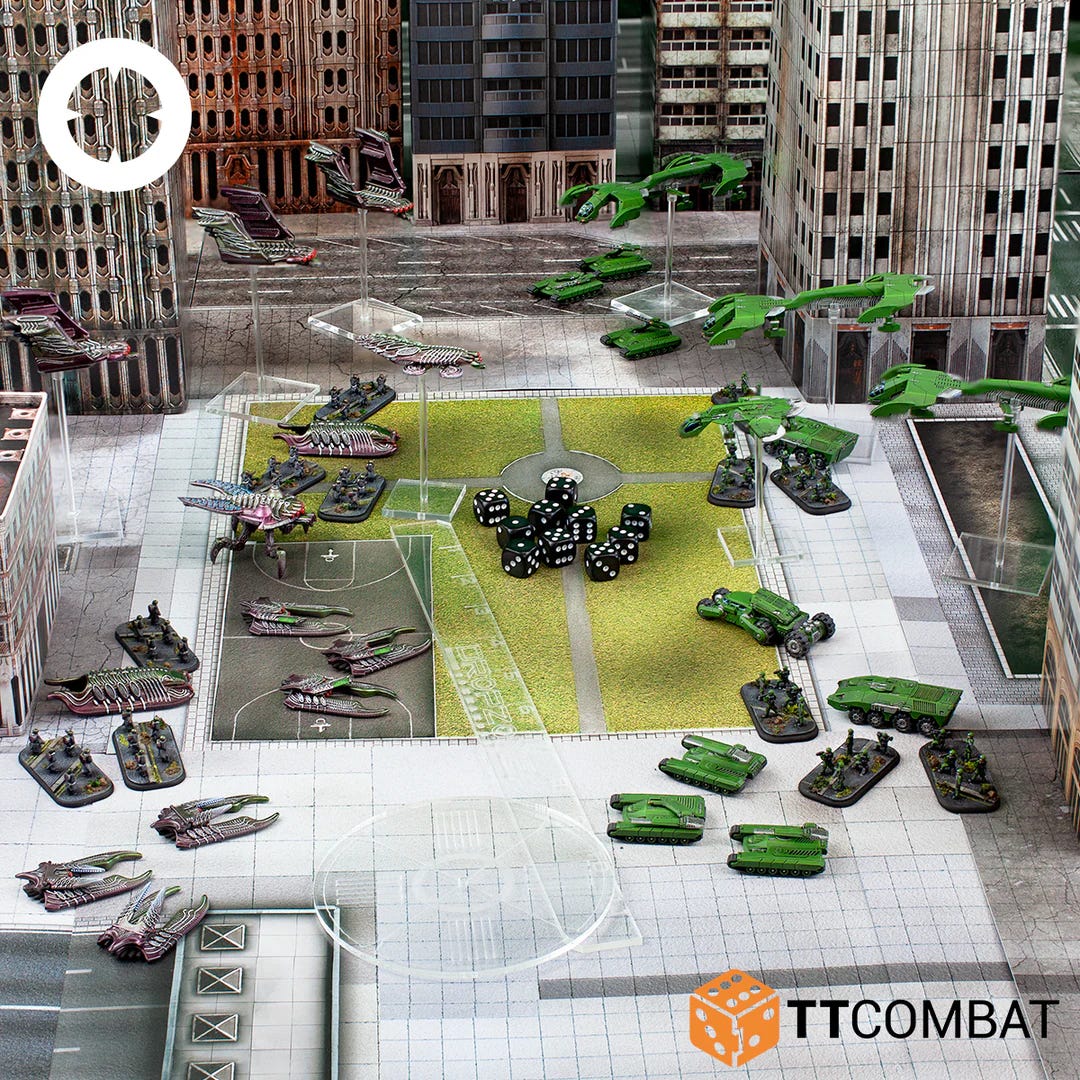
The ‘Dropzone Commander’ sci-fi wargames rules already assumed that on a future battlefield all forces would have drones and ECM operating to such an effect that modern units had no choice but to close to exceedingly close range to properly engage and do damage to the enemy.
Should other future war-games make that same assumption or build in ECM and drone technology as just a given core aspect?
Or should they be purchasable upgrades or nation-specific advantages?
Should the environment be a factor? Could the terrain or weather of any given scenario or campaign either limit or make more effective/less effective, ECM?
Logistics
Attacks on HQs, supply bases and training fields have all taken place during the war in Ukraine. These have been directed by special forces, satellite reconnaissance and drone reconnaissance. Precision guided artillery, drones, air launched missiles, and long-range artillery rockets have all done considerable damage.
As such, future war games should consider logistics more closely, not just as potential objectives in a scenario but as a potential pre-game affect or during the game affect. What if you could inflict ammo shortages by a short mini game before the main event? Or an appropriate upgrade or dice roll?
Both players, depending on the nation, faction or scenario, could both benefit and be penalized depending on their logistical situation, especially in a campaign.
Precision fires
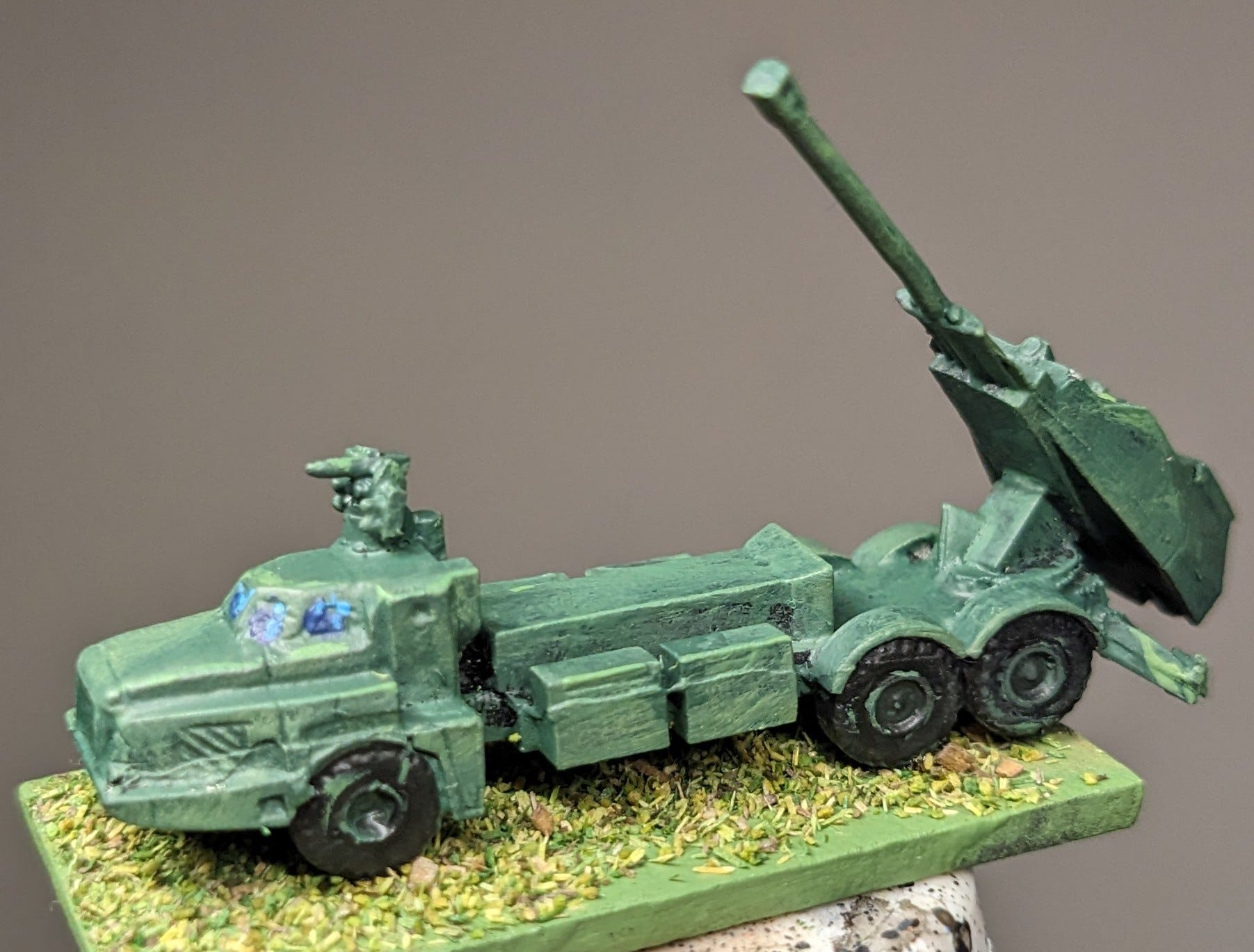
Calling in artillery support is already taken into account by many modern warfare war-games, for example ‘Cold War Commander’
But what about precision fires with the likes of cruise missiles or HIMAR’s, or using the latest in precision artillery pieces like my pictured Archer system?
These have a devastating effect if properly employed. What if they could be replicated on the wargaming table?
Air superiority
What ‘air superiority’ can really be defined as, needs to change. Can one claim to have air superiority if the enemy is able to continue to deploy Recon and FPV drones? Could instead of defining air superiority as ‘total’ or ‘contested’ do we need other levels?
Could wargames define a ‘drone’ and ‘aircraft’ level of air dominance? What affect, as already mentioned, would ECM have on both true aircraft and drones?
Mass attacks
Ukraine has seen the return of ‘mass attacks’ were large numbers of infantry and vehicles assault positions, either in large numbers at the same time (North Korean troops in Kursk in 2024) or small numbers over time (standard Russian tactics today see 2 or 3 man teams attacking individually all the time). As horrifying as these attacks are for the brutal dis-regard they show for human life, how do you replicate these on the table top?
Does modern wargaming need to re-introduce the idea of ‘Dragoon’ troops? Dragoon cavalry were those trained to use their horse to approach the enemy, then dismount and fight on foot. This happened a lot during the American Civil War and World War 1. Frontelligence has directly referenced this style of attack in his understanding of the Russian wave attacks in Ukraine, that make use of everything from ATV’s to Electric scooters to close with the enemy.
Tanks
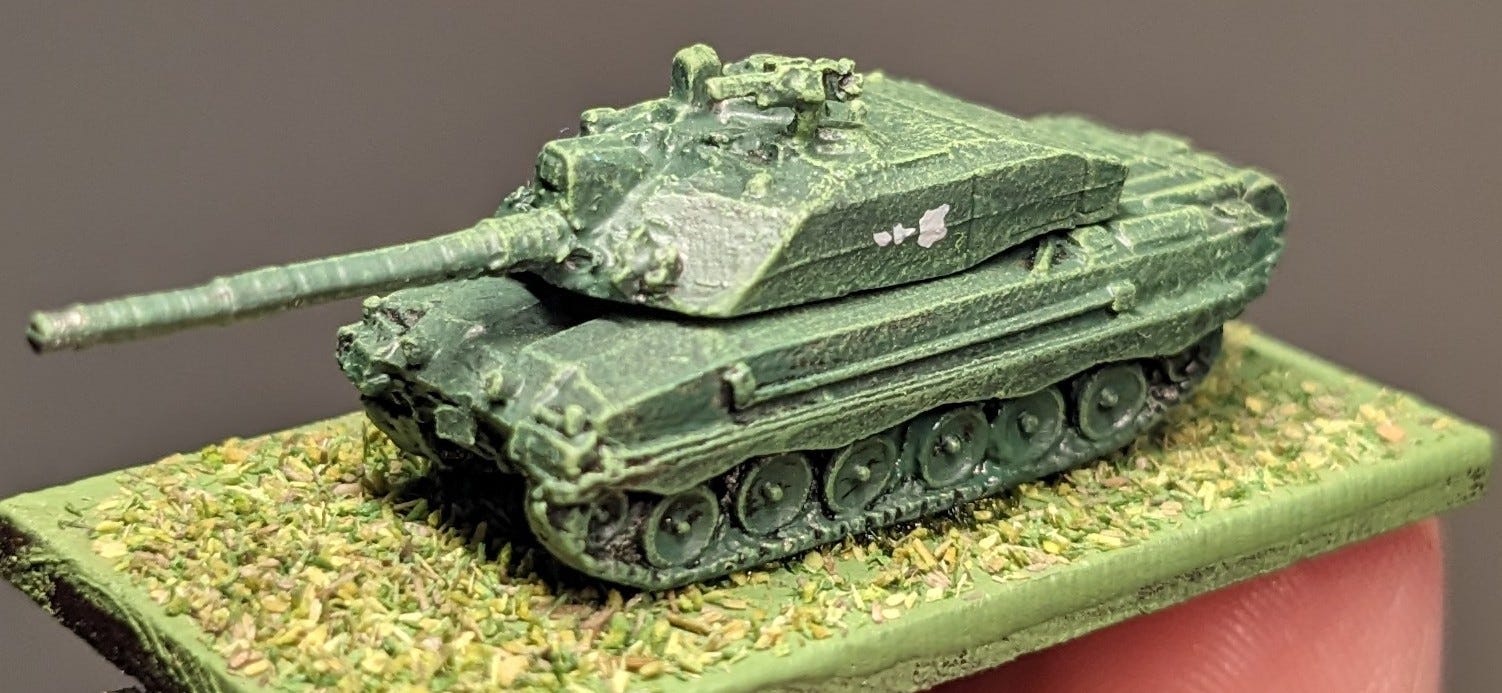
What of the tank? Will it become a become a less used ‘accessory’ to military endeavours or will it return as a premier assault element?
Will types of tank start to come into service. Russia, with its anti drone adoptions, has effectively reintroduced the assault gun. Ukrainian troops fondly refer to the British challenger 2 tank as a sniper tank due to its accuracy over extreme distances. The same is said for the old but still effective leopard 1 tank from Germany.
Will the inherent differences between eastern and western tanks be taken into account? Whilst Russian designed tanks are lighter and typically faster, they have a marked tendency to explode spectacularly losing both vehicle and crew. western tanks in comparison have better crew protection and more advanced systems but are typically available in smaller numbers.
Conclusions
Ultimately Modern Warfare will find itself encroaching on what would have been previously considered science fiction. Drones, artificial intelligence, battlefield sensors even laser weapons. These are not science fiction anymore, they are science fact and their use is only going to increase in the years ahead.
Wargaming both from a commercial and a professional point of view is going to have to adapt and adapt very swiftly.
From a commercial point of view both Modern Warfare and science fiction games if they want to keep up, need to move their timelines forward, in their considerations.
if drones are to be part of a science fiction background war game, then research will need to be done to make them sufficiently more advanced than what drones already exist.
And likewise any Modern Warfare war game will need to take into account the much more advanced inventories of individual military forces that are coming online. reorganisations of major military nations are happening right before our eyes based not just on the conflict in Ukraine but the perceptions of what Modern Warfare is going to look like into the decade ahead.
Meanwhile, professional wargaming again will need to update its rule sets. Established assumptions about how wars are fought have been blown out of the water by the way both Russia and potentially China will fight their wars. Hybrid warfare and disinformation are not just niche considerations; they are the way individual nations now fight. Methods of replicating their effect on other nations need to be considered for future wargaming scenarios.
I know this article has been more questions than answers, but I hope it has been a useful exercise and an interesting read.
Much of this is being done already in the professional and semi-professional wargame space. For an example of the latter, see Littoral Commander.
I wonder if it might make sense for drones & electronic warfare to be largely abstracted in larger games? Once you’re at the point of manoeuvring companies rather than platoons I think it’s less about inflicting casualties than multiplying the ‘battlefield friction’ the enemy is subject to. So if the enemy has ‘superiority’ then you might struggle to activate formations or have them subject to an ‘under fire/suppressed/buttoned up’ type penalty when acting.